
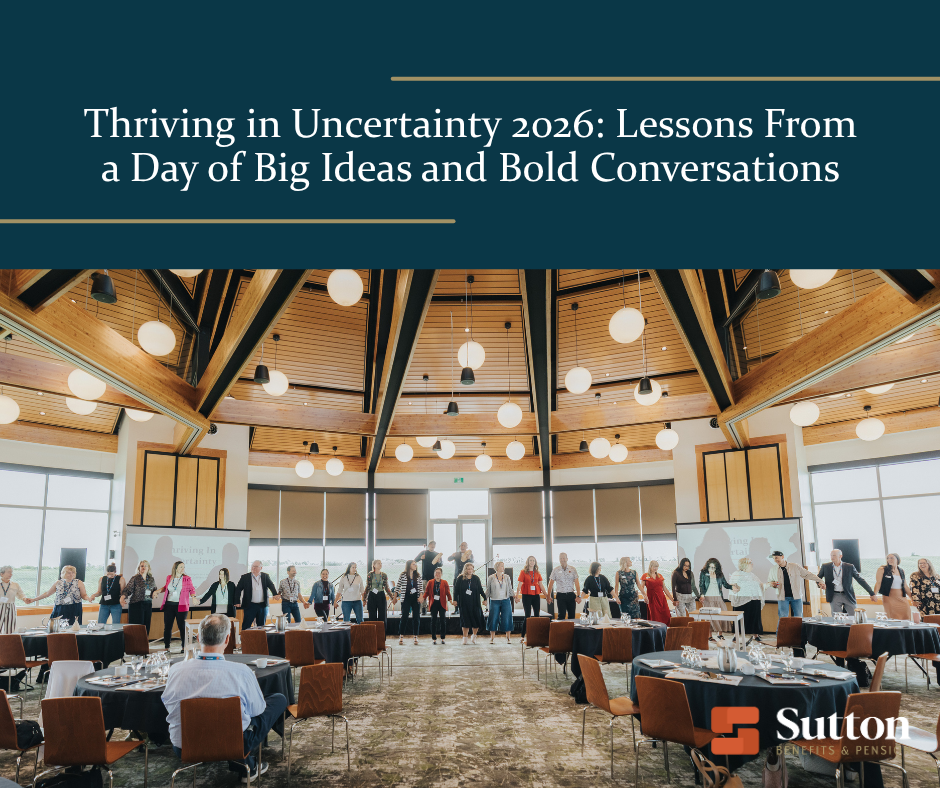
There’s a particular kind of energy in a room full of business and HR leaders who have chosen to step back and think bigger in the middle of a busy week. That was the feeling at Sutton’s second annual Thriving in Uncertainty conference, hosted at Wanuskewin with sweeping views of the river valley and that wide-open prairie sky. The room buzzed before the event even began.
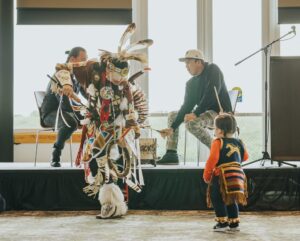 It opened in a good way, with the Walkingbear family from Thunderchild First Nation. Chicken dancer Ryzen Walkingbear and his son gave a powerful performance, accompanied by traditional drummers, and the family led a round dance that invited everyone in the room to join. It grounded the day in connection, culture and respect.
From there, host Jenn Minor Johannson gave the audience a simple but effective assignment: capture 12 great ideas over the course of the day and leave with one “I will…” statement. It was a small framing that turned a day of listening into a day of doing.
The economy: more solid footing than the headlines suggest
Pierre Cléroux, BDC’s Chief Economist, kicked off the conference with “BDC’s Economic Outlook 2026: Navigating Uncertainty and Building What’s Next,” and his message was more reassuring than many expected.
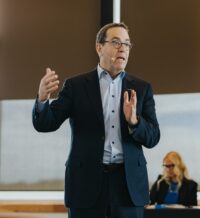 Cléroux argued that Saskatchewan isn’t in a recession, largely because our core industries are less exposed to tariffs than other provinces. The province posted the country’s best growth in 2025 at 2%, and is expected to see 1.9% GDP growth in 2026.
The fundamentals behind that strength are familiar local ones: Canada is well-positioned in oil reserves, with production rising; uranium demand is climbing; potash is healthy if variable; and housing prices are rising here even as they soften elsewhere.
That wasn’t to say there aren’t challenges. Cléroux noted that the working-age population will grow more slowly over the next five years as immigration policy tightens and Baby Boomers retire. On surviving a flat labour force, his advice was direct: learn to grow without adding headcount, using AI and automation to make the team you already have more effective.
Better benefits: “Does the turkey still make sense?”
 Andrea Hansen and Jenn Minor Johannson led a workshop on attracting and retaining employees through better benefits. In one memorable moment, Sutton staff members carried in three giant binders labelled “1,500 reasons employee benefits matter,” and Andrea jokingly threatened to read through every one.
Andrea shared a few important statistics, including that 35% of Canadians would take a lower salary for better benefits, and that four in five employees consider cutting benefits unacceptable.
 But listing a thousand reasons why employee benefits matter wasn’t the point of the workshop. Instead, the goal was to get people talking.
Attendees were the first to watch a video case study about Crestline Coach, a local ambulance manufacturer that has done an incredible job of elevating its employee benefits as part of its growth strategy.
 The conversation kept circling back to a single question every leader should ask: “Does the turkey still make sense?” Years ago, Crestline gave every employee a Christmas turkey until someone gently noted it wasn’t much use to a single employee living alone.
The lesson wasn’t about turkeys, it was about designing benefits for the people you actually have, and being willing to evolve as generations and definitions of “family” change.
Mental health at work: naming what’s really going on
Crystal Bell and Cris Tello from EHN Canada delivered a grounded, practical session on mental health benefits, timed well for Men’s Mental Health Month in June — a fitting reminder, given that men tend to access benefits far less than women.
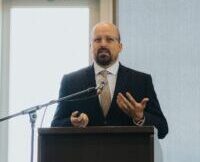 Burnout is widespread, reported by 39-47% of workers, and costs $5,500 to $28,500 per employee each year. Yet EAP utilization stays low, partly because people assume it won’t help and partly because stigma persists. Some find it easier to ask for help with an addiction than with their mental health.
The presentation offered concrete signposts to watch out for in your employees. For example, a bad day or even a bad week is normal, but a low mood that lasts two weeks or longer is a red flag, and people who are struggling usually show several changes at once.
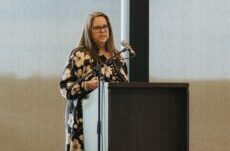 Their guidance for managers was refreshingly human: protect confidentiality above all, and don’t have these conversations in your office, where the power dynamic makes people feel they’re in trouble.
Most managers (67%) don’t feel equipped to have those conversations in the first place, which is exactly why services from organizations like EHN can be so valuable. They offer training for managers, as well as accessible virtual care.
The keynote: from burnout to breakthrough
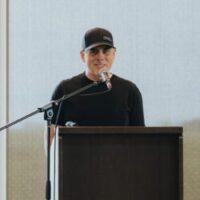 The event closed with keynote speaker Trevor Muir, and his talk “From Burnout to Breakthrough: How Caring Became Our Competitive Advantage” may have been the most talked-about of the day. Trevor shared the story of scaling a company past $125 million in revenue before hitting a personal breaking point that reshaped how he leads. His through-line was that putting people first isn’t soft; it’s strategy, the thing that drives performance and builds teams resilient enough to last.
Nicole Nickel of Crestline Coach said Trevor gave her the single biggest takeaway of the conference. She pointed to his “champagne glass theory” — the idea that we should fill ourselves up first so that what naturally overflows benefits the people around us — and to his nudge to shift from “someday” to “today” by taking action instead of waiting.
“You feel uplifted when you leave,” she said, “because you get so many takeaways that are enlightening.”
Those were the ideas she found herself discussing in the parking lot and turning over in her mind on the drive home.
Why it mattered
Jason Aebig, CEO of the Greater Saskatoon Chamber of Commerce, noted that the sessions built on one another, so insight from one carried into the next. The stat that stuck with him was Cléroux’s on our aging population, and what it means for Generation X, the “sandwich generation” caring for adult children and aging parents at the same time.
 “They need more than checkups and massages,” he said. “Organizations that get this right tap into a new reality.”
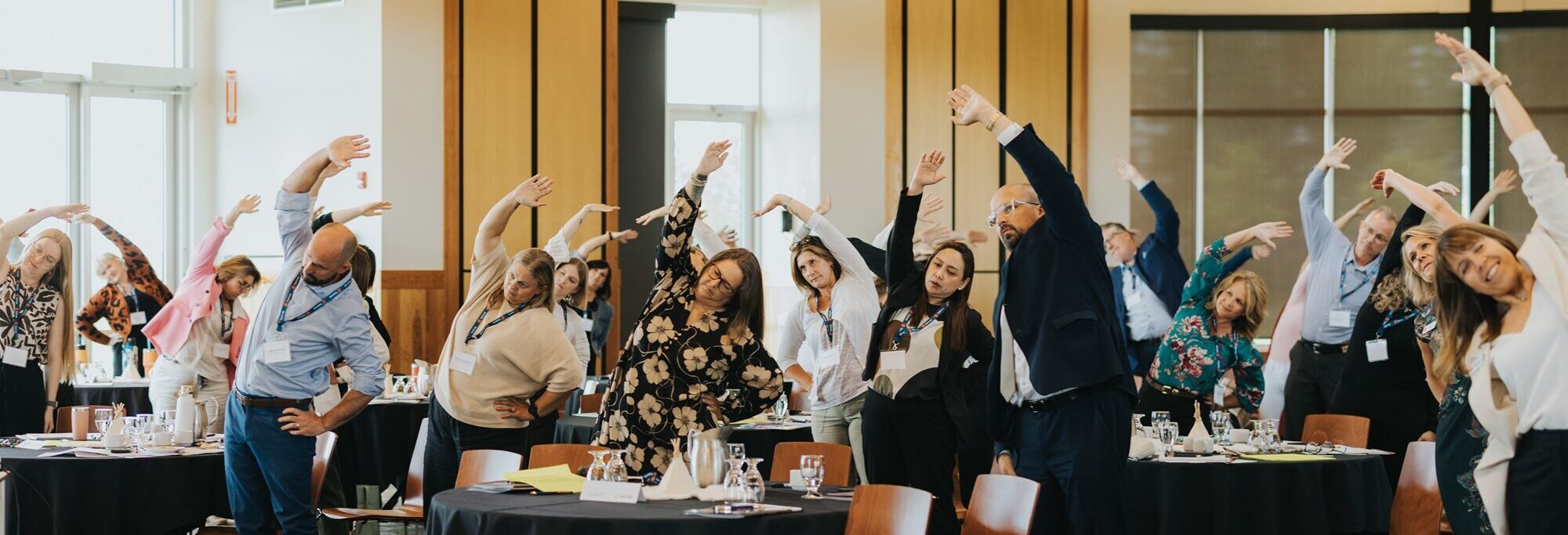
Add in music from the Harreson James Band, a stretch break from Donald Physiotherapy, and bannock alongside hearty chilli at lunch, and it felt less like a conference and more like a community.
Sutton called the day Thriving in Uncertainty, and the world actually felt a little more certain by the day’s end, not because the challenges had disappeared, but because attendees had spent a day getting a grip on them together.
See you next year
If you missed this year’s event, make sure you don’t miss the next one! Mark your calendar now for June 8, 2027 and watch for registration details when they’re announced. Sutton plans to make the day’s insights worth it, but the real value is in the conversations at your table, the ideas you’d never have reached on your own, and that rare feeling of leaving more energized than you arrived.
Be sure to watch our 2-minute client story featuring Crestline Coach. It offers a quick look at how a strategic benefits partnership can make a real difference. If you’d like to see the full 7-minute version with more of the story and insights, contact us and we’ll be happy to send it your way.